Crystal or Himalayan Singing Bowls
Crystal bowls are fused quartz sold by the note, and they can break. Himalayan bowls are bronze heard for their overtones, and they dent instead.
You can start with either kind, and the two can be played together.

How Each One Is Made
A Crystal Bowl Is Fused Quartz
It begins as silica sand, quartz that weather has already broken down and one of the commonest materials on the Earth. Nothing precious is ground up to make it. The sand is fused at very high heat into a bowl, and the result is a kind of glass with unusual resonance.
The instrument is modern. Fused quartz crucibles were made to grow the silicon that computer chips are cut from, and somebody found that one sang when a mallet circled its rim. Most bowls are made in China. One Ohio manufacturer has told a federal court that its singing bowls and its industrial crucibles are the same object, and that it supplies many retailers with similar and sometimes identical bowls.
Frosted bowls are big and heavy, the loudest kind and the least costly. Clear bowls are thinner and quieter, with a purer tone and a very long ring. Gemstone bowls, sold as alchemy bowls, are quartz with color added.
A Himalayan Bowl Is Bronze
Most are bell metal, copper alloyed with tin. A traditional bowl is cast, then shaped by hand with a hammer that leaves its marks on the surface. Others are turned on a lathe.
Sellers call them Tibetan or Himalayan. Most bowls sold as Tibetan are made in Nepal and northern India, so this guide says Himalayan.
Two bowls of the same size can sound very different, and a photograph will not show it. A shop will often list one bowl under two notes: sung around the rim, it gives a low note, and struck, a higher harmonic.
“Knowing where a bowl came from has never once changed what it does in a room.”
Hamid Jabbar
How They Sound in a Room
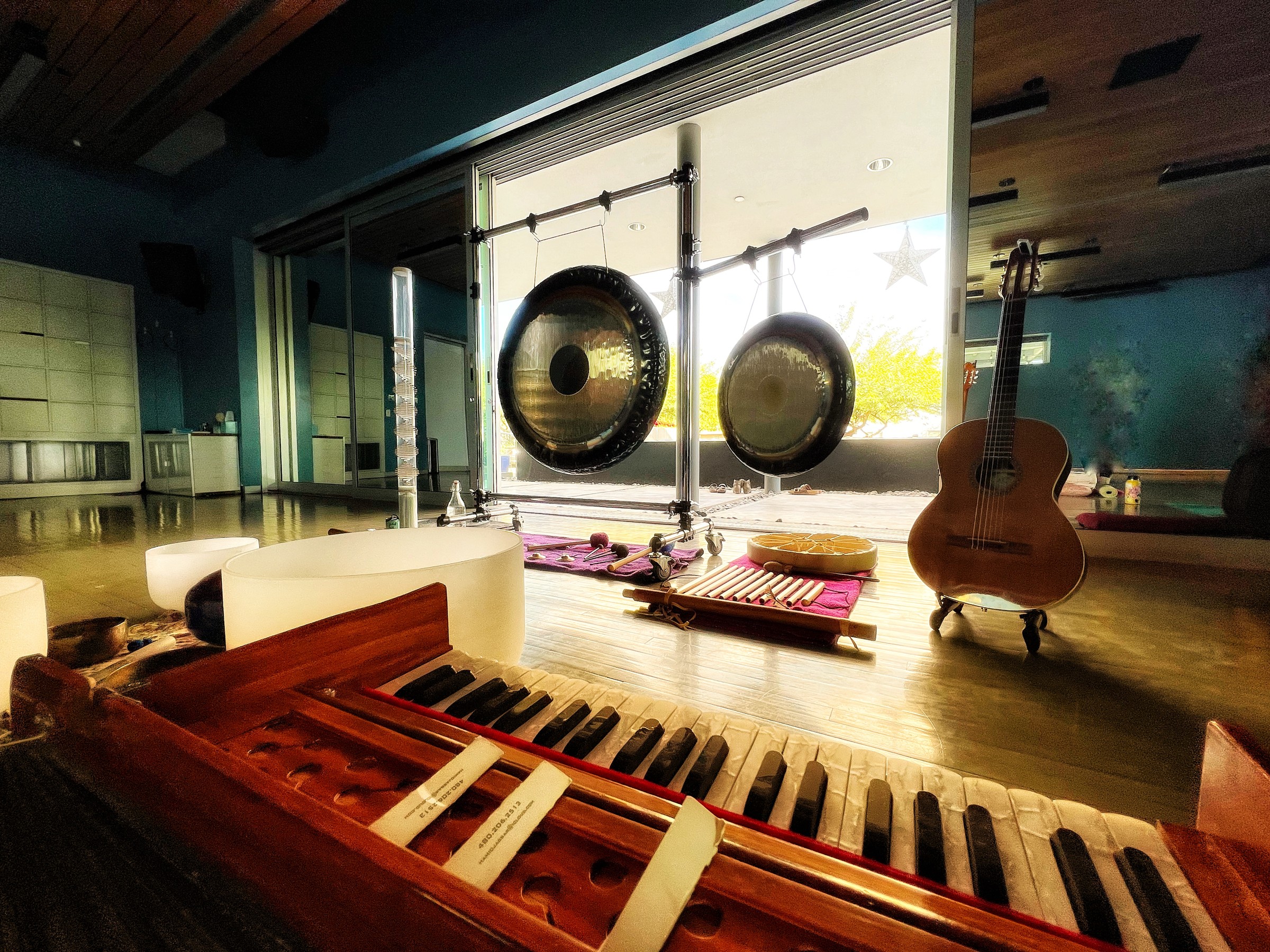
Sing a frosted crystal bowl and the note it was sold as swells and holds, clean and steady. One or two large frosted bowls can carry the low end of a whole session. A clear bowl is quieter and rings long after the mallet leaves it. Like a metal bowl, it gives a low note sung and a high harmonic struck.
A Himalayan bowl sounds less like one note and more like a gong. Its sound comes from overtones rising out of the metal more than from a single fundamental.
With Other Instruments
Crystal bowls are tuned to the same equal tempered scale as a harmonium or a Native American style flute, so a bowl in the right key sits inside the music. Hamid's own course breaks down how to play your voice, one crystal bowl, a harmonium worked with your foot and a flute together.
The two kinds can be played together too. For any pairing, set a new bowl beside one you own and listen for whether they agree.
Crystal and Himalayan Bowls, Side by Side
| Compared | Crystal | Himalayan |
|---|---|---|
| Made from | Silica sand, which is quartz, fused at very high heat. | Bell metal, which is copper alloyed with tin, cast and hammered by hand or turned on a lathe. |
| Made in | Mostly China. Some are made or finished in the United States. | Mostly Nepal and northern India. |
| The sound | The note it is sold as, when sung. A clear bowl struck gives a high harmonic. | A low note when sung and a higher ring when struck, with overtones above both. |
| In a room | Frosted bowls are loud and hold the low end. Clear bowls are quiet and ring a long time. | Closer to a gong, heard more for its overtones than for one note. |
| Tuning | Sold by note, often as 432 Hz or 440 Hz. | Often listed under two notes for one bowl. |
| Playing | Sung around the rim or struck gently, with rubber on rough frosted bowls and suede on smooth ones. | Sung and struck the same way. |
| If dropped | It can crack or shatter, and a crack cannot be repaired. | It can dent, and it usually survives. |
| Weight and travel | Frosted bowls are heavy for their size and travel in padded cases, often nested. | A small bowl packs into a bag. A large one can weigh ten pounds or more. |

Playing a Singing Bowl
A bowl is sung or struck, crystal and metal alike.
Singing
Press the mallet against the outside of the rim and circle it. The note grows out of the friction. Begin with firm pressure and a quick circle, then slow the circle and lighten the pressure as the note comes up. A rattle means the bowl is vibrating hard against the mallet: lift the mallet off and let the bowl sing on its own.
Striking
A strike gives a bell tone and brings the upper overtones forward. Strike gently: a crystal bowl hit hard can break. Some players, after the Plum Village tradition, say a bowl is invited instead of struck, and the word tends to soften the hand.
One Hand, Then Two
Begin with one bowl at a time, low to high, letting each strike overlap the last a little. A whole session can be played that way. Next comes the drone: one hand keeps a low bowl quietly singing under a rubber mallet while the other plays over it.
How bowls fit into a session is in how to lead a sound bath.
Caring for a Bowl and Traveling With It
Crystal is glass. A hard strike can crack a crystal bowl, a drop onto a hard floor usually ends it, and a crack cannot be repaired. Keep each bowl on its rubber ring, back from the edge of a table, and carry it with two hands.
Frosted bowls are heavy for their size. They travel in padded cases, and a set can travel nested, one bowl inside the next, each in its own sleeve.
Metal is forgiving: a Himalayan bowl that falls usually comes away with a dent. A small one packs into a bag and survives the trip, and the biggest weigh ten pounds or more.
Either kind rests on a ring or a ring cushion while it is played, so it does not slide or buzz against the floor.
Which Suits a First Sound Bath
Either kind can carry a first sound bath. What matters more is that you have heard the exact bowl and want to keep listening to it.
Crystal is the easier start. It sounds beautiful from the first afternoon, and a frosted bowl is the least costly way to a big sound. Playing one well is still a long way from easy.
Buying a Bowl
Play the bowl you are buying, or buy from someone who has played that exact bowl and will tell you honestly how it sounds. Sing it, take the mallet away and count how long it rings. Strike it softly and listen for overtones that sit still.
Read past the story on the listing. Where the sand was mined has little to do with how a crystal bowl sounds, and a brand's name is often not the maker's. Hamid's article on quartz crystal singing bowls says more about where they come from and what the marketing words mean.
“The instruments that do the most are often the plain ones.”
Hamid Jabbar
JABBAR15
Fifteen percent off at Soundtopia, entered at checkout.
Where to Buy a Bowl
Hamid sells no bowls. For bowls, try Soundtopia, where the code JABBAR15 takes fifteen percent off.
The Soundtopia link is an affiliate link. Hamid earns a commission if you buy through it, at no extra cost to you.
Contact Hamid for help sourcing an instrument that is hard to find.
The GongSpace list
Join the List and Take $29.80 off Hamid's Own Course: $268.20 Instead of $298.
The code is shown at once and emailed to you, by Hamid Jabbar PLC, which owns GongSpace.