How to Lead a Sound Bath
The people on the mats do the listening. Your work is everything around it, from setting the room to the silence at the end.
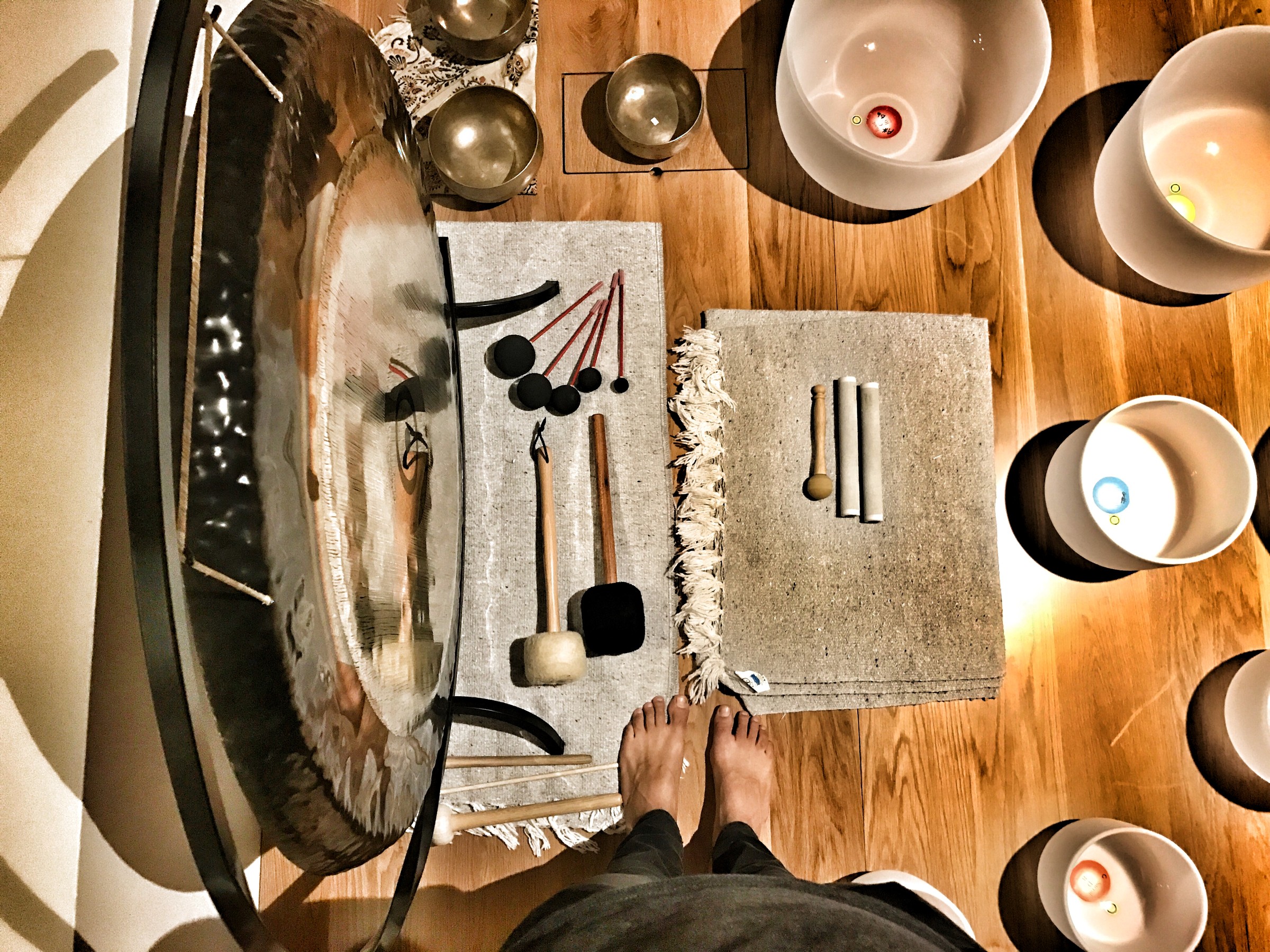

Setting the Room Before Anyone Arrives
Arrive about an hour before a group comes in, to set up the instruments and the room.
Listen to the empty room first. Once everyone is quiet, an air vent or a road outside becomes part of the sound bath. Switch off what you can, and pick an hour when the street is calm.
Put the instruments at one end and lay the mats facing them, with an aisle from the door. Keep the first row a few steps back from the gong, since the nearest mat hears it loudest.
Give each mat a bolster, with a blanket within reach, since someone lying still for an hour gets cold. Let people choose to lie down or sit up. Most lie on their back with the bolster under the knees, some on one side. Chairs work as well, even in a ballroom set in rows for a company.
Ask people to come ten minutes early, and shut the door at the start time. A latecomer crossing the room is heard by everyone.
Keep the room plain and put your effort into the sound, since every eye will be closed. Play without amplification if you can, because it is complicated to get right. A large venue that needs it may need a professional sound engineer.
What to Tell People Before the Sound Begins
Talk for a few minutes before you play. Say how long the sound will last and what they will hear. Tell them they can shift or sit up at any point, or leave quietly, and that nobody will be watching anybody.
Ask people to close their eyes and stay awake. Name what they are about to do: you can call it sound meditation, since the listening belongs to the people lying down.
Tell them how to listen and what to listen for. There is the amplitude, which is the volume. There is the range of frequencies, the highs, the lows and the spaces in between. And there is modulation, the wobble or “wah-wah” that happens naturally as the sound rings.
Then let the room go quiet. Lights down, phones off, and a few breaths of silence before the first sound.
“They tell you what they are about to do and roughly how it works, because a person who understands what is happening to them takes part instead of waiting.”
Hamid Jabbar, of the practitioners worth learning from
The Sequence of a Sound Bath, From First Sound to Silence
A sound bath has a shape over time. To lead a whole session from a page, use the sound bath sequence and script, which gives the words to say in each part.
Begin
Start softer than feels natural. Play a light stroke on the gong, or one bowl, and let it ring before the next sound. In the first minutes the room is working out how closely to listen.
Build
Add one layer at a time. Bring a second instrument in underneath the first and keep the gong moving. Raise the level slowly enough that nobody could say when it got louder.
There is no need for silence while the sound builds. You do not always have to wait for one sound to fade before the next, and the layers can overlap. Silence is still one of the strongest tools you have, and where you use it is your own preference.
Hold
At the fullest point, stop climbing and hold the level for a few minutes. A well played gong gives a wall of overtones with a root tone inside it. Loud is easy on a gong, and a room reaches its limit long before the instrument does.
Much of where to go from here is felt, an exchange between you and the room. Sometimes you lean in and take people further, and sometimes you back off. Learning to sense that, and to hold the space while you do, is a large part of learning to lead.
Settle
Take the sound down the way it came up: fewer instruments, softer strokes, longer gaps. Let the gong carry the last of it, or end on a single bowl.
Silence
When the last sound has gone, leave the silence alone for longer than feels comfortable. It is part of the session, and the hardest part to play.
“By Level II the technique is mostly there. What is left is knowing when not to play, and that is the part that separates a session that lands from a session that is merely loud.”
Hamid Jabbar, on what remains to learn by Level II
Which Instruments to Use, and Where They Go
Build the session around gongs and bowls. Your first sound bath can be led with one gong and a few singing bowls.
The gong can come in at any point, at the beginning, in the middle or at the end.
Singing bowls give long single tones that suit the start and the settling. Metal Himalayan and crystal bowls sound quite different under the same mallet, and the two kinds are compared in their own guide.
A drone holds the middle together. A shruti box or a harmonium holds it under everything else, and a voice held on one note over it brings up harmonics of its own. A flute or a voice gives the room a melody to follow for a while.
Chimes, rain sticks and an ocean drum work at the edges, for moving from one part of the session to the next.
Play every sound by hand, as it happens, instead of using a loop pedal, which repeats a phrase on a fixed cycle.
“Instruments played by hand never quite repeat. Strike a gong the same way twice and it does not give you the same sound twice, and that small unreliability is what lets attention stop bracing.”
Hamid Jabbar, Red flags in sound healing
The guide to sound bath instruments says what to buy first and what can wait. To strike and rub the gong without a crash, read how to play a gong for a sound bath.
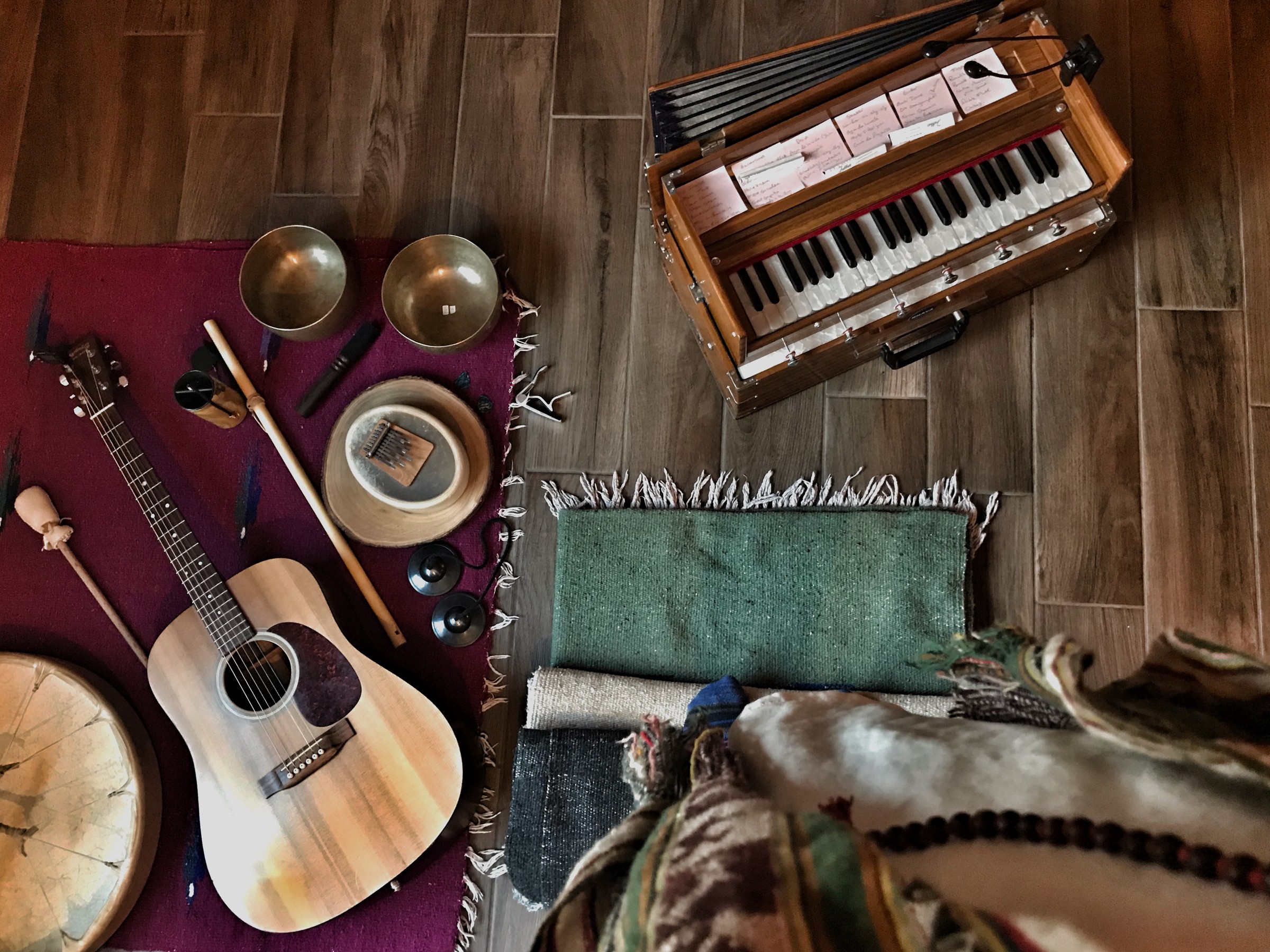
Bringing People Back at the End
After the last sound, keep still and let the silence run for a minute or two before anyone speaks.
Then speak quietly, close to the level of the last sound. Invite people to move their hands and feet, roll onto one side, and sit up when they are ready.
Bring the lights up slowly. Wait a few minutes before talking at a normal volume, and let people leave in their own time.
Thank them and say how to leave the room. What each person heard is theirs to describe.
“The job of the person with the mallet is to keep the conditions good and then get out of the way.”
Hamid Jabbar
Holding the Room While You Play
Holding the room is mostly attention. Listen to what you play, and keep a second ear on the room: breathing, a cough, someone sitting up.
Pace the session by the clock and by the room. Set rough times for each part beforehand, and keep a watch where you can see it without moving.
Play for the person nearest the gong. A level comfortable at the front is comfortable everywhere.
Someone sitting up or opening their eyes has made a choice that needs nothing from you. If someone leaves, keep playing at the same level so the rest of the room carries on.
Snoring happens in a room of people lying still. A change of instrument is a gentler answer than a word.
How Long a Sound Bath Lasts
Most sound baths run 45 to 90 minutes, and most last about an hour. A session of 20 to 30 minutes can open a conference before the first speaker.
Your first sound bath can be shorter. Thirty to forty-five minutes is easier to shape well than an hour, and a clear shape counts for more than length.
Leading a Group, or One Person
With a group, the instruments stay at the front and the level is set for the whole room.
With one person, the instruments can come closer and the levels come down. Follow their pace, and agree beforehand how they will tell you if they want it quieter.
“A sound practitioner holds space with sound, for a room of people or for one person at a time.”
Hamid Jabbar
Questions People Ask About Leading a Sound Bath
How long should a sound bath be?
Most sound baths run 45 to 90 minutes, and most last about an hour. A session of 20 to 30 minutes is enough to open a conference, and a first sound bath of your own can be 30 to 45 minutes.
What do you say to people before a sound bath?
Say how long the sound will last and what they will hear, and that they are free to move, sit up or leave quietly at any point. Ask them to close their eyes and stay awake.
Do people have to lie down for a sound bath?
No. Let people choose to lie down or sit up. Chairs work as well, even in a ballroom set in rows.
Can a sound bath use a loop pedal?
Leave the loop pedal out and play every instrument by hand. A loop repeats a phrase on a fixed cycle that a listening mind learns to predict.
What instruments do you need to lead a sound bath?
One gong and a few singing bowls are enough for a first sound bath.
The GongSpace list
Join the List and Take $29.80 off Hamid's Own Course: $268.20 Instead of $298.
The code is shown at once and emailed to you, by Hamid Jabbar PLC, which owns GongSpace.